

What Is Crib 5?


I’m Hannah Shore, Head of Sleep Science and Trade Expert at Mattress Online. In this guide, I’ll explain exactly what Crib 5 fire regulations mean for commercial mattresses and beds - including what’s tested, who must comply and how to check your products meet the correct standards.
The Crib 5 fire regulations refer to a set of strict UK fire safety tests that mattresses and upholstered furniture are strongly recommended to meet in all commercial properties.
These requirements come under The UK Furniture and Furnishings (Fire) (Safety) Regulations 1988[1] and Furniture and Furnishings (Fire) (Safety) (Amendment) Regulations 2025: UK[2] - two of the toughest fire safety laws in the world.
While some low-hazard settings may legally use domestic-grade furniture, doing so requires a robust fire risk assessment, and even then, insurers or fire officers may not accept it. If a fire occurs and your furniture isn’t Crib 5 certified, you could face invalidated insurance, liability issues, fines or prosecution.
In practice, choosing Crib 5 is the safest and most reliable way to ensure your furniture meets the level of protection expected in commercial environments.
Note: The following information applies to UK fire safety regulations only. Rules differ across Europe and internationally

Jump to
- Who this guide is for
- What does Crib 5 mean?
- Why is Crib 5 testing important?
- What is the Crib 5 test?
- How are contract beds fire tested?
- Crib 5 vs domestic standards
- Who needs Crib 5 furniture?
- Why following UK Crib 5 regulations is heavily recommended
- How to check if an item is Crib 5 certified
- References:
Who this guide is for
This guide is designed for anyone responsible for buying, supplying or managing mattresses and beds in commercial or hospitality settings.
It’s particularly useful for:
- Hotel and guest house owners
- Holiday let and Airbnb hosts
- Care home managers
- Student accommodation managers
- Facilities and property managers
- Furniture buyers and trade professionals
If you provide sleeping accommodation for paying guests, residents or staff, the information in this guide will help you understand your legal fire safety responsibilities and choose fully compliant Crib 5 mattresses and beds with confidence.
What does Crib 5 mean?
The Crib 5 fire rating (also known as Ignition Source 5 or Medium Hazard) is the fire safety standard for commercial furniture in the UK.
It refers to a series of fire resistance tests to ensure mattresses, beds and other upholstered items are resistant to ignition and self-extinguish if exposed to a flame.
Being Crib 5 certified doesn’t make furniture fireproof, but it means the materials:
- Resist ignition
- Self-extinguish within a set timeframe.
This drastically reduces flame spread, protecting both lives and property if a fire was to occur.Domestic mattresses are tested to lower ignition sources. Whereas contract mattresses and beds pass Medium Hazard testing to be used in commercial or hospitality settings.
Why is Crib 5 testing important?
The purpose of Crib 5 fire regulation testing is to:
- Check how materials react to potential ignition sources
- Prevent flames from spreading quickly
- Minimise fire damage
What is the Crib 5 test?
To earn Crib 5 certification, contract mattresses and contract divan bases and mattress toppers must pass three progressive fire safety tests:
- The smouldering cigarette test
- The match test
- The Crib 5 test
These tests are carried out by accredited fire safety laboratories using 50x50cm mattress samples, repeated multiple times to ensure consistent results.
1. The smouldering cigarette test (BS EN 597-1)
Test code: BS EN 597-1
This is a mandatory baseline test for every mattress, including domestic and commercial products.
This is the first stage of mattress fire safety testing and must be passed before Crib 5 certification.
- A lit, unfiltered cigarette is placed in several positions on the mattress surface - such as along tufts, tape edges and seams - and left to burn out completely. For mattresses, the ‘sleep surface’ means both sides must be tested. For mattresses and toppers, the ‘sleep surface’ refers to both sides, so each side must be tested.
- Each test is repeated several times to confirm accuracy.
The mattress will pass if it does not ignite, smoulder, or continue to burn - it must self-extinguish within the required timeframe.

2. The match test (BS EN 597-2)
Test code: BS EN 597-2
This is the second mandatory fire-resistance test that all mattresses, both domestic and commercial, must pass. It’s often called the ‘No Ignition Test’.
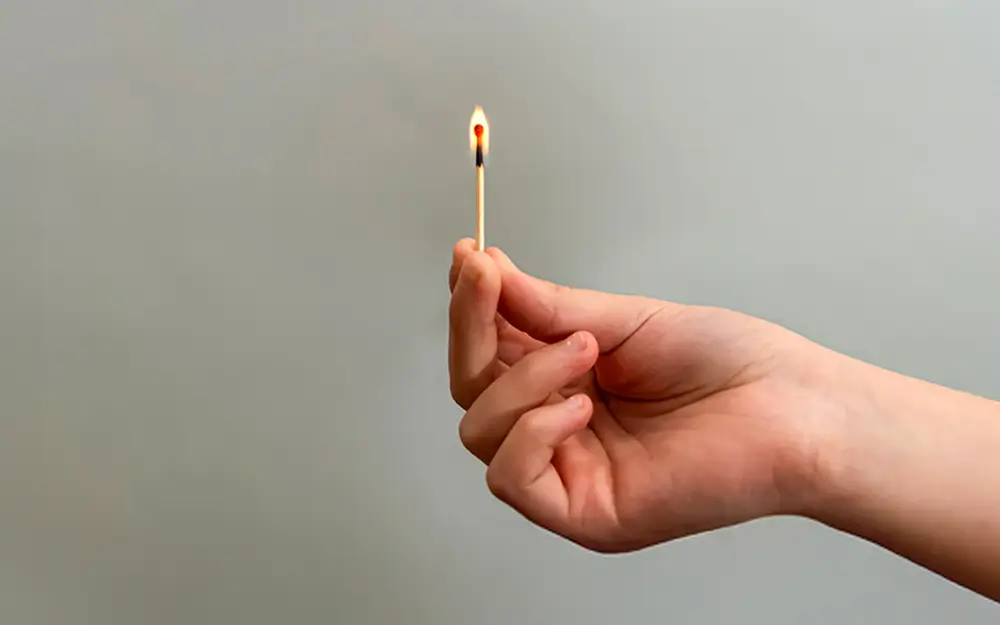
- A lit match is held to several points on the mattress or mattress topper sample for 20 seconds - for example, in the stitching, against the micro-quilting, or along the tape edge.
- Each test is repeated several times to confirm accuracy.
The mattress will pass if it does not ignite, smoulder, or continue to burn - it must self-extinguish within the required timeframe.
3. The Crib 5 test (BS EN 6807, Source 5)
Once a mattress has passed both previous tests, it can be approved for Crib 5 testing.
- A small wooden ‘crib’ structure (hence the name Crib 5), hot-glued together, is placed on the test sample with fabric and lint inside.
- An accelerant is added and the crib is set alight.
- This process will be repeated several times to ensure validity.
To pass, the mattress must self-extinguish within 10 minutes and show no continued smouldering once the crib burns out.
Crib 5 testing for foam mattresses
Foam contract mattresses must also pass an additional L Fire Test (Schedule 1, Part 1).
This test applies to all foam products in the UK, including mattresses, toppers, pillows and headboards under the UK Furniture and Furnishings (Fire) (Safety) Regulations 1988 (Schedule 1, Part 1)[1] .
In this test, two pieces of foam are joined to form an ‘L’ shape. A flame is applied in the corner, and the sample must self-extinguish without continuing to burn or smoulder.
Together, the cigarette, match, and crib tests make up BS 7177 certification - the full fire safety standard required for all commercial-grade mattresses and beds.
The Crib 7 test (BS EN 6807, Source 7)
For high-risk environments such as prisons, offshore facilities and some healthcare settings, Crib 7 (BE EN 6807, Source 7) testing is required.
This uses larger, more intense ignition sources and represents the strictest level of flame resistance under UK law.
The British Standards behind Crib 5
The Crib 5 classification is supported by several British Standards (BS codes):
| British standard | Test name | Applies to |
| BS 7177 | Combined Fire certification (BS EN 597, BS EN 597, BS EN 6807, Source 5) | Commercial |
| BS EN 597 | Cigarette test | Domestic & Commercial mattresses |
| BS EN 597 | Match test | Domestic & Commercial mattresses |
| BS EN 6807, Source 5 | Crib 5 test | Commercial mattresses |
| BS EN 6807, Source 7 | Crib 7 test | High-Risk |
| BS 7176 | Upholstered furniture panel fire safety standard | All upholstered furniture such as headboards, bed frames and chairs. |
How are contract beds fire tested?
The fire tests required for a contract bed depend on the type of bed:
- Divan beds (box-style bases) are tested in the same way as mattresses. This includes applying the cigarette test to the top surface where the mattress would sit. They must pass the cigarette test, match test and Crib 5 test.
Upholstered bed frames and headboards are treated as upholstered furniture (similar to sofas). These are tested to BS 7176, which covers Schedule 4 and Schedule 5 of the UK Furniture and Furnishings (Fire) (Safety) Regulations 1988[1].
Schedule 4 - smouldering cigarette test
Schedule 4 assesses how upholstery materials react to a smouldering cigarette, similar to the BS EN 597-1 test[3].
In this test:
- All materials are soaked in water and then left to dry.
- A smouldering cigarette is placed directly onto the fabric sample.
- Components are tested individually to ensure validity.
Schedule 5 - match test
Schedule 5 assesses how the bed’s upholstery materials react to a lit match, similar to the BS EN 597-2 mattress test[4].
In this test:
- All materials are soaked in water and then left to dry.
- A lit match (or equivalent flame) is applied to the fabric sample.
- Components are tested individually to ensure validity.
BS EN 6807 - Crib 5 test
Upholstered bed frames and headboards use the same Crib 5 ignition source as contract mattresses (BS EN 6807, Source 5), but with one key difference: all fabrics must be water-soaked and dried before testing, in line with Schedule 4 and 5 requirements.
The Crib 5 procedure itself is the same as for mattresses:
- A small wooden ‘crib’ structure is placed on the test sample, packed with fabric and lint.
- An accelerant is applied and the crib is set alight.
- The test is carried out multiple times to ensure accuracy.
These tests confirm the materials resist ignition and smouldering even after cleaning or long-term use.
Crib 5 vs domestic standards
When it comes to mattresses, the key difference between domestic and commercial fire safety is the level of ignition testing required.
Here’s a quick comparison of the composite mattress tests for each setting:
| Standard | Applies to | Composite mattress tests required |
| Domestic | Homes | BS EN 597-1 (Cigarette test)BS EN 597-2 (Match test) |
| Commercial | Commercial & hospitality settings | BS EN 597-1 (Cigarette test)BS EN 597-2 (Match test)BS EN 6807 (Crib 5 Test) |
Please note:
This table only compares the tests applied to the finished mattress composite. Other mattress components follow separate testing rules:
- All foam (Schedule 1, Part 1) and all latex (Schedule 1, Part 3) must be fire-tested individually, regardless of whether the product is domestic or commercial.
- Divan bases are tested in the same way as mattresses:
- Domestic: Cigarette and Match tests
- Contract: Cigarette, Match and Source 5 tests
- Upholstered bed frames and headboards follow furniture-standard testing (Schedule 4 and 5), including water-soaking the fabric and testing with cigarette, match and Crib 5 sources, in line with BS 7176.
This means Crib 5 mattresses can safely be used in homes, but domestic mattresses are not recommended for use in commercial environments.
Who needs Crib 5 furniture?
Crib 5 compliance applies to any business supplying or using upholstered furniture in a commercial setting, including, but not limited to:
- Hotels and guest houses
- Holiday parks and short-term lets
- Care homes
- Student accommodation
- Public buildings and hostels
It’s the business or property owner’s legal responsibility to ensure compliance with the correct fire safety standards for their establishment.
If you’re unsure, contact your local fire officer - they can confirm which fire safety regulations your establishment must meet.
Why following UK Crib 5 regulations is heavily recommended
If a fire officer has declared that your property must meet Crib 5 standards, it is your legal obligation under UK Fire Safety Law[1] to comply.
Following Crib 5 standards ensures:
- Compliance with UK Fire Safety Law[1]
- Valid fire insurance coverage
- Safer environments for staff, guests and residents
What happens if you don’t have Crib 5 furniture?
Non-compliance with UK Fire Safety Law[1] is a criminal offence and can result in:
- Fines of up to £5,000 per non-compliant item
- Up to 6 months imprisonment
- Invalidated insurance in the event of a fire
- Enforcement action
- Reputational damage
Beyond compliance, the Crib 5 certification helps protect lives and ensures peace of mind for you and your guests.
How to check if an item is Crib 5 certified
You’re responsible for ensuring your mattresses and beds meet the correct fire safety standards.
Look for certification labels such as:
- ‘Crib 5’
- ‘Ignition Source 5’
- ‘BS 7177 - Contract Use’
- ‘BS 7177 - Certified’
If you’re unsure, request documentation from the manufacturer directly.
At Mattress Online, all our contract mattresses and beds are Crib 5 tested and meet the latest UK fire safety regulations.
Crib 5 certification isn’t just a legal requirement, it’s your assurance that every contract mattress or bed you provide meets the correct UK fire-safety standards.
Looking for Crib 5 compliant furniture? Explore our trade-approved ranges:
For more trade insights, visit the Trade Advice Hub for expert guides on compliance, product selection and safety.
References:
- The Furniture and Furnishings (Fire) (Safety) Regulations 1988 (no date) legislation.gov.uk. Available at: https://www.legislation.gov.uk/uksi/1988/1324/contents.
- Furniture and Furnishings (Fire) (Safety) (Amendment) Regulations 2025: UK (no date) GOV.UK. Available at: https://www.gov.uk/government/publications/furniture-and-furnishings-fire-safety-regulations/furniture-and-furnishings-fire-safety-amendment-regulations-2025-uk.
- The Furniture and Furnishings (Fire) (Safety) Regulations 1988 (no date) legislation.gov.uk. Available at: https://www.legislation.gov.uk/uksi/1988/1324/schedule/4.
- The Furniture and Furnishings (Fire) (Safety) Regulations 1988 (no date) legislation.gov.uk. Available at: https://www.legislation.gov.uk/uksi/1988/1324/schedule/5.
About our Team
 Fact Checked
A University of Oxford-trained sleep specialist and published researcher, Hannah's dedicated to improving your sleep through evidence-backed advice and product insights.
Sales Enquiries
Mon-Sat: 9:30am - 5:30pm
Sunday: 10am - 4pm
Customer Service
Mon-Sat: 09:30am - 17:30pm
Sunday: Closed
customerservice@mattressonline.co.uk


