
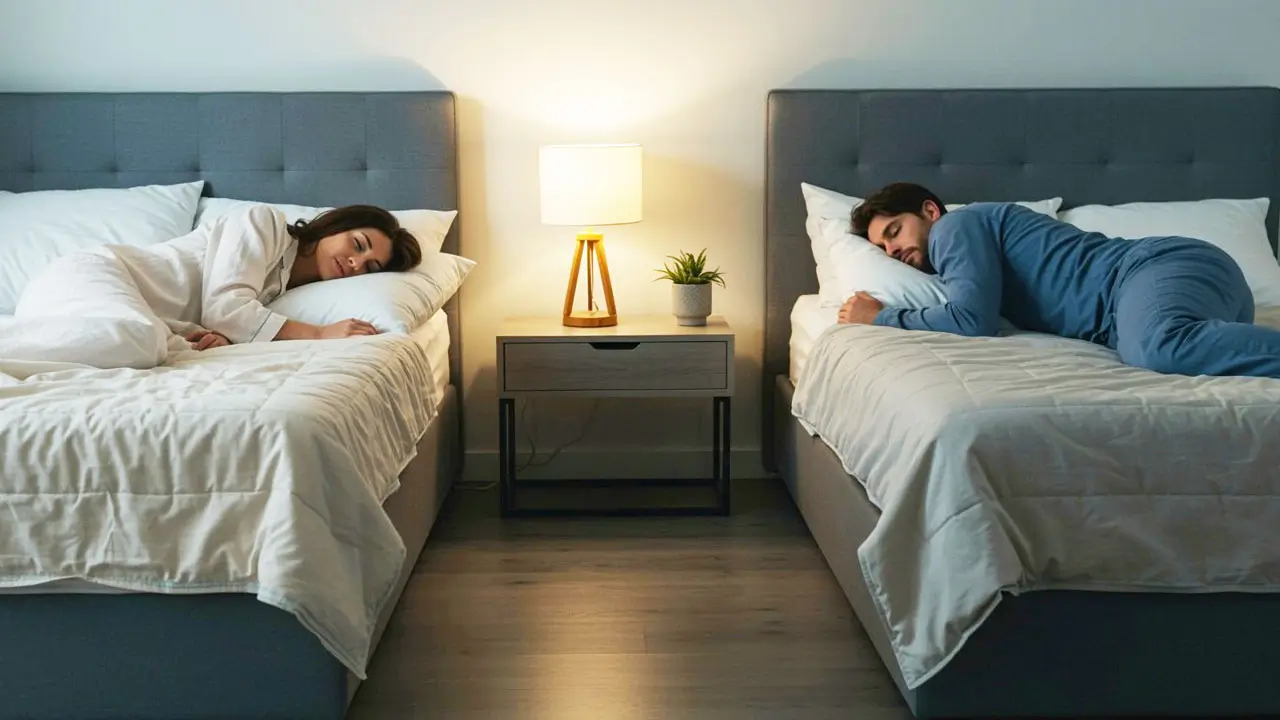
Sleep Divorce: What It Really Means and When It Actually Helps


There’s a moment in a lot of relationships when one partner lies there and wonders whether they’d actually sleep better in the other room. Maybe you’ve had the thought yourself. And with a name like “sleep divorce,” maybe you’ve been afraid of what it would mean to even say it out loud.
It doesn’t come from anger. It comes from a stretch of nights of being jabbed by an elbow, jolted awake by snoring, or peeling yourself off your partner’s arm at 2am in a bedroom that feels like a slow oven. You love this person. And you have tried everything to make it work.
What Sleep Divorce Actually Means
Somewhere along the way, this got labeled “sleep divorce.” Which, honestly, is a heavy name for what is usually a very practical decision two tired people make.
All it means is that a couple decides to sleep in separate beds or separate rooms so they can both actually rest. No paperwork, no announcement, no crisis. Some couples do it every night, others only on the roughest ones.
Some sleep specialists prefer softer names like “sleep alliance” or “sleep separation,” which describe the same idea without the charged language of “divorce.” Separate sleeping used to be pretty standard for married couples, and even now, plenty of couples have been doing it for years without ever putting a name on it. They just didn’t tell anyone.
You’d Be Surprised How Many Couples Are Doing It
A 2023 American Academy of Sleep Medicine survey found more than a third of adults occasionally or consistently sleep in another room to accommodate their partner. Millennials do this nearly twice as often as Baby Boomers. So if you’ve been assuming everyone else is happily curled up together while you lie there listening to snoring at 2 in the morning, no, they’re not. A lot of people are making a different choice than you think.
The Body Heat Problem (and Why Summer Makes It Worse)
There’s a real biological reason a lot of couples reach for the guest room, and a lot of it comes down to temperature. Your body has to cool down to fall asleep, and warm air plus a second body’s heat makes that much harder. In cooler months, shared warmth is part of why sharing a bed feels good. In warm months, it can turn your side of the bed into a slow cooker.
In short: your body is trying to cool down, and your partner is a walking radiator.
A lot of couples slide into seasonal sleep divorce without ever calling it that. Someone ends up on the couch, or someone moves to the guest room for the hot stretch of the year, and they sleep better. That’s often when the real conversation starts.
How Sleep Debt Reshapes a Relationship
Poor sleep doesn’t just make you tired. Over time, it changes who you are in your own relationship.
When you’re running on empty, the parts of your brain that handle patience and emotional regulation take a hit. You get shorter, small things start to feel bigger, and you find yourself misreading a sigh or bristling at a comment that wasn’t loaded. Your usual “I love you, have a good day” comes out flat, and neither of you quite knows why.
In my work with couples, I see this all the time. Two people who love each other, running on years of sleep debt, slowly building a frustration that has nothing to do with the relationship and everything to do with exhaustion. When a couple tells me separate sleep saved their marriage, they’re describing what happens when two well-rested people stop running on fumes around each other.
The Surprising Science of Sharing a Bed
Here’s a piece most sleep divorce articles skip. When shared sleep works, it actually has real biological benefits. Research on couples using brain-monitoring equipment found they got about 10 percent more REM sleep together than apart, and their sleep stages synchronized across the night. The closer the couple felt emotionally, the tighter that synchronization was.
In short: when it works, sharing a bed doesn’t just feel connective. It literally is.
But there’s a catch. REM is the stage most tied to emotion regulation and how well you handle each other the next day. If one partner’s sleep is being wrecked every night by snoring, restlessness, or heat, none of those benefits land. Sleep divorce isn’t automatically better. What matters is which arrangement gives both people rest.
When Sleep Divorce Genuinely Helps
Sleep divorce makes the biggest difference when couples are dealing with loud chronic snoring, very different chronotypes, shift work, or one partner who’s chronically restless. It also helps in the hottest stretches of summer when shared body heat becomes almost impossible to sleep through, or when you want the room set up in completely opposite ways. One of you wants it freezing and pitch black. The other wants a fan on, a nightlight, and the door cracked. In those cases, separate sleep often improves rest quickly, and being rested tends to bring couples closer, not further apart.
Try These Before You Move Rooms
You don’t have to go all the way to separate rooms right away. A few smaller changes will often get you there.
The Scandinavian sleep method. Two separate duvets on one bed. This one small change solves temperature clashes, blanket theft, and much of the tossing-and-turning that pushes couples apart. Especially in summer, when one of you wants no covers and the other still wants something over them, that alone does it for a lot of couples.
The twin-bed trick. Two twin beds pushed together, each with your own fitted sheet, mattress, and pillow, and a single king comforter laid across the top. From outside, it looks like one bed. Inside, you each get your own sleep surface, temperature, and space. It’s a trick I love because it solves the awkwardness that stops a lot of couples from trying separate sleep at all.
A bigger mattress. Each partner gets more room to move and more distance from their partner’s heat. If you’ve been sharing a smaller bed for years, you’ll feel it the first night.
A motion-isolating mattress. Modern mattresses with pocket springs or memory foam absorb partner movement, so you barely feel them shifting. If your partner is a mover, this one change can shift how you feel about sharing a bed.
Get the snoring evaluated. Loud, consistent snoring is a health issue, not a personality quirk. Both partners’ sleep, and the snorer’s long-term health, depend on it.
When Life Stage Changes What You Need
Sleep needs shift a lot across a lifetime. What worked at 30 rarely works the same at 50. Perimenopause and menopause bring hot flashes that turn shared body heat from cozy to unbearable in about 10 seconds, and summer only makes it worse. New parents often need to protect one person’s sleep so at least one adult can function the next day. And with aging, sleep gets lighter and wake-ups more frequent.
In short: your sleep needs will change over time, and your setup should be allowed to change with them.
Staying Close When You’re Sleeping Apart
One of the biggest worries about separate sleep is losing the closeness that comes with sharing a bed. It’s a real concern, but intimacy doesn’t have to disappear. It just stops happening on autopilot.
Say goodnight with intention. A kiss, a real goodnight, a few minutes talking about the day. Small rituals carry more weight when they’re chosen rather than automatic.
Keep the main bed as shared space. Morning coffee together, weekend mornings, Sunday reading. The bed can still belong to both of you even if only one of you sleeps in it.
Weave affection through the day. Hugs when someone gets home, hand-holding on the couch, a back rub during a show. Physical closeness doesn’t have to happen at night to happen.
In my work, I’ve actually seen a lot of couples become more affectionate after moving to separate sleep. They were finally rested enough to want to be. Solving the sleep problem often solves the closeness problem too.
How to Have the Conversation
The hardest part of sleep divorce, honestly, is talking about it. It’s easy for a partner to hear “I want to sleep in the other room” as “I want space from you,” when what you actually mean is “I want to sleep so I have anything left for us.”
If you’re thinking about it, talk about it during the day, not the middle of the night when you’re both frustrated. Frame it around sleep quality and how you want to show up in the relationship. Treat it as an experiment, not a permanent verdict.
Your Bedroom Setup Matters
Whether you share a bed or sleep apart, the room itself does a lot of the work. A supportive mattress, breathable bedding, and a cool, dark room help both partners get deeper rest. In summer especially, cooling materials and airflow can make the difference between a night you actually sleep and one you just endure. And if you go with separate sleep, give the second setup the same care as the main one. A guest bed no one has thought about in five years isn’t going to give you the rest you’re chasing.
The Bigger Picture
Sleep divorce isn’t a sign that a relationship is failing. Most of the time, it’s a sign that two people were finally honest about what wasn’t working. For some couples, that looks like separate beds. For others, it’s a bigger mattress, two duvets, or finally treating a snoring problem. The right answer is the one where you both wake up rested and still want to reach for each other.
The bed was never really the point. Being rested enough to actually enjoy the life you’re building together was. However you and your partner decide to get there, you’re not doing anything wrong.
References
- American Academy of Sleep Medicine, Sleep Prioritization Surveys (2023, 2024)
- The Sleep Foundation
- The Sleep Charity
- NHS sleep guidance
- Drews, H.J. et al. (2020). Bed-Sharing in Couples Is Associated With Increased and Stabilized REM Sleep and Sleep-Stage Synchronization. Frontiers in Psychiatry.
About our Team
Licensed clinical psychologist Dr. Kimberly Ann Lemke is an internationally recognised expert on the science of sleep - through her groundbreaking Drift® Method, she helps people prevent fatigue and burnout by focusing on daily habits. She is an award-winning entrepreneur and author.
Related Articles

Teenagers and Sleep: Why the Body Clock Shifts (and How to Work With It)


Sales Enquiries
Mon-Sat: 09:30am - 5:30pm
Sunday: 10am - 4pm
Customer Service
Mon-Sat: 09:30am - 5:30pm
Sunday: Closed
customerservice@mattressonline.co.uk