

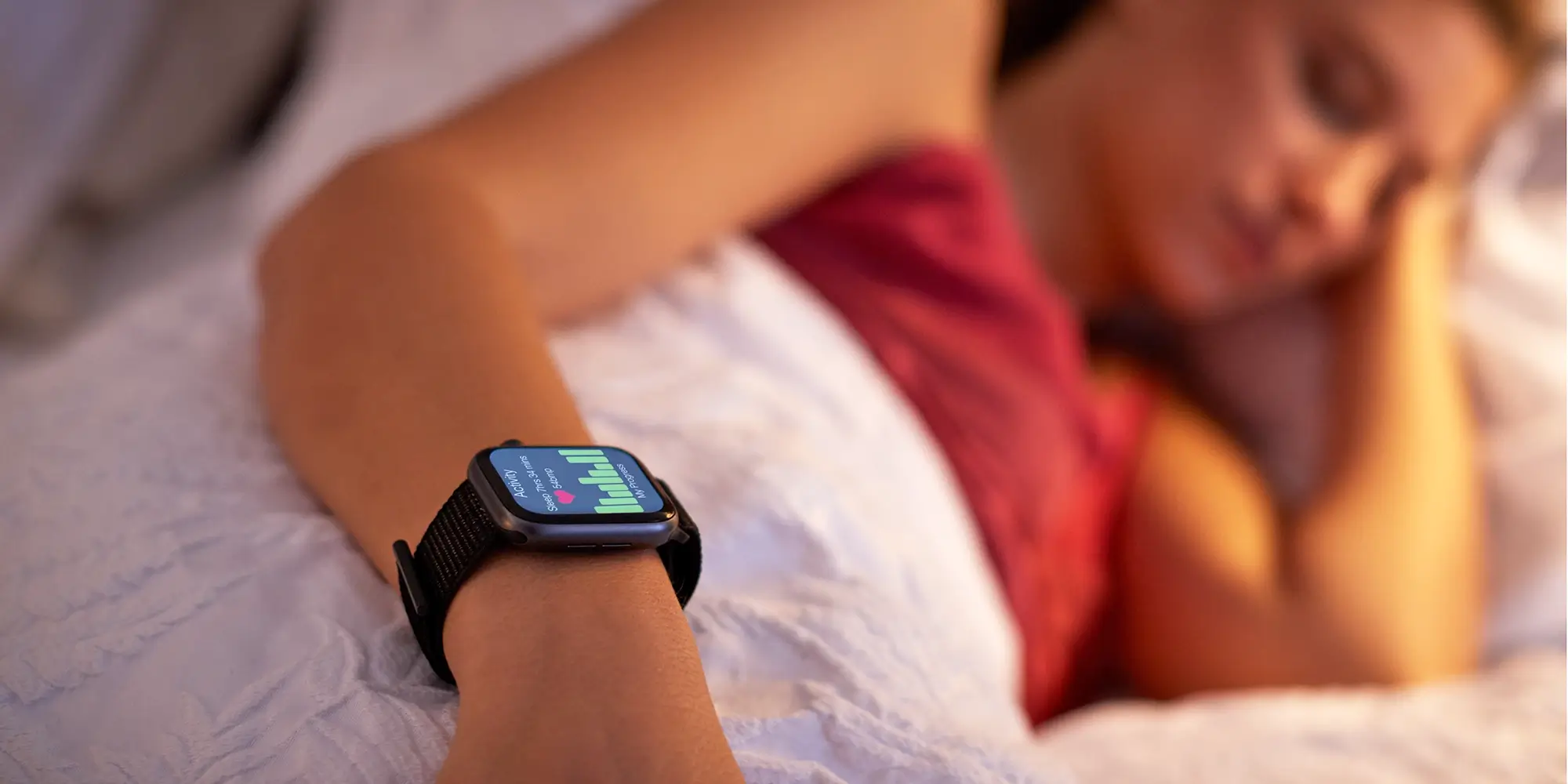
Are Sleep Trackers Helping Your Sleep? Or Hindering It?


As a population, we're spending billions to track and optimise sleep. Just recently, Oura hit an $11 billion valuation, WHOOP hit $10 billion, and the new Fitbit Air just dropped.
Now everyone wants to know which one is best and the difference between them.
But nobody's asking the more important question - are any of them actually making you sleep better at night, and perform better in the day?
So let’s start here - are they worth it?
I'm going to give you the answer you don't want to hear.
Probably not.
First, figure out why you even want one, because nobody genuinely needs one. We didn't have them 20 years ago, and we don't need them now. These sleep scores you see plastered over the internet: 98%, 76%, 52%, etc, all seem really interesting, but they don't mean much.
They're just rough estimates of your sleep based on heart rate, movement, and temperature. The only way to accurately track your sleep is with polysomnography (PSG), which involves analysing your brain waves during sleep.
So if the score itself means very little, is there any use for them?
I can think of one main one: measuring improvements over time.
Although the sleep score isn't the most reliable, if you make a positive change that benefits sleep, you can see what difference it actually makes. For example, if every time you use a sleep mask, your scores improve by 5-10 points, it's probably worth using. Conversely, if every time you scroll on your phone before bed, it drops 10-20 points, it's probably worth stopping. But it’s even more important to track how you felt you slept - more on that later.
So why are we so obsessed with sleep trackers?
It comes down to humans' innate desire to always improve and progress. That's also why high performers use them more than anyone else. They're so used to maximising their performance in all other areas (work, gym, finances) that they want to do the exact same here.
I'm all for maximising performance and productivity, but this isn't the way you achieve that. The tracker gives you an idea of what's going on with your sleep. It doesn't give you any guidance on how to improve it.
It's like having £100k in the bank but not being able to withdraw it. What's the point in looking at a number on a screen if you can't do anything with it?
And actually, these sleep trackers have been shown to lead to worse performance.
A study conducted by Draganich and Erdal looked at the effects of showing people their REM sleep duration on their performance (1).
Two groups:
- Group A: were shown a higher duration REM sleep
- Group B: were shown a lower duration REM sleep
Group B had worse decision-making, lower energy, and impaired cognitive function. Even though the number was completely made up, their REM sleep wasn’t even tracked.
Basically, how they thought they slept mattered more than how they actually did sleep.
How accurate are they anyway?
A 2021 study found that Fitbit only accurately identified deep sleep 59% of the time, REM sleep 69% of the time (2), and was only 38% accurate when estimating how long it takes people to fall asleep (3). So tracking deep sleep and REM sleep, which people care about most, are actually the least accurate!
Two studies decided to compare the accuracy of these sleep trackers against PSG (the test that measures brain activity I mentioned earlier).
Robbins et al. compared three popular trackers against polysomnography (4). But it’s worth noting this study was funded by Oura, so take it with a pinch of salt.
| Device | Deep Sleep Accuracy | REM Accuracy |
| Oura Ring Gen | 79.5% | 76.0% |
| Fitbit Sense 2 | 61.7% | 67.6% |
| Apple Watch Series 8 | 50.5% | 82.6% |
Schyvens et al. compared six devices and had no industry funding (5).
| Device | Deep Sleep Accuracy | REM Accuracy |
| Whoop 4.0 | 69.6% | 62.0% |
| Apple Watch Series 8 | 50.7% | 68.6% |
| Fitbit Charge 5 | 51.5% | 60.0% |
| Fitbit Sense | 50.9% | 61.3% |
| Garmin Vivosmart 4 | 47.5% | 33.1% |
The key takeaway is none of these devices are fully accurate, even WHOOP and Oura are off by over 30%. So that’s why you should never let a low or high amount of deep or REM sleep on a tracker control how you feel in the day - it may not even be a true reflection.
The problem with chasing perfect sleep
Obsessing over perfect sleep is counterproductive because there's no such thing. Your body is not a machine, and you can't pre-program the quality of your sleep the night before. Trying to maximise your sleep scores can also lead to something called Orthosomnia, where the anxiety and stress around these scores actually lower sleep quality itself (6). So the quest to achieve the best sleep ends up making it worse.
Ironic, right?
Here’s what to focus on instead
I've created a more effective system that lets you track your sleep and performance without spending a single penny, and it's what I use with my clients.
Write down these 3 things every morning:
- Sleep quality /10
- Morning energy /10
- Stuck to 2 habits that help your sleep (Yes/No/Partly)
Sleep quality is just how you feel you slept, because this actually tells you far more about your sleep than any sleep tracker can. Wake-ups in the night can be normal, but only you know how much they're affecting your sleep - the data can’t tell you this.
Morning energy shows whether you feel groggy and exhausted, refreshed and alert, or anywhere in between. It's a good measure of how productive you’ll be that morning.
Lastly, avoiding one bad habit that worsens your sleep and adopting one habit that improves it is a very easy way to start increasing deep and REM sleep within one week without any major overhauls. I saw one of my clients go from 11 minutes of deep sleep to 1 hour 22 minutes in one week just by doing this.
These were individual nights, so take with a pinch of salt, but she often got under 45 minutes of deep sleep, now gets over 90 minutes most nights, and no longer has the afternoon energy crash or brain fog she used to experience daily.
What actually matters
If my clients already use a sleep tracker, I check out the data. But honestly, I don't really care about the scores, and neither should you. Don't get me wrong, seeing over an hour increase of deep and REM sleep is cool, but here's what's cooler:
Waking up feeling refreshed, ready to attack the day, and being able to focus all day long with no tiredness. That's what will allow you to perform at your best consistently and achieve your goals way faster, because you can literally gain back 2-4 productive hours every day.
That's 10-20 hours every work week, 40-80 hours every month, and 240-480 hours over the next 6 months.
Seriously think about the amount of stuff you could get done with that time. Build your dream body, double your business, get promoted, spend more time with your family, etc. The possibilities are endless and very achievable.
But you don't get there by waking up and letting a sleep score decide how you perform. You get there by tracking how you feel and perform, and adjusting your habits, behaviours, and routine based on what most improves your energy, focus, and productivity.
Less tracking, more changing
References
- Draganich C, Erdal K. Placebo sleep affects cognitive functioning. J Exp Psychol Gen. 2014;143(2):539-49.
- Conley S, Knies A, Batten J, Ash G, Miner B, Hwang Y, et al. Agreement between actigraphic and polysomnographic measures of sleep in adults with and without chronic conditions: a systematic review and meta-analysis. Chronobiol Int. 2021;38(7):1010-22.
- Menghini L, Yuksel D, Goldstone A, Baker FC, de Zambotti M. Performance of Fitbit Charge 3 against polysomnography in measuring sleep in adolescent boys and girls. Chronobiol Int. 2021;38(7):1010-22.
- Robbins R, Weaver MD, Sullivan JP, Quan SF, Gilmore K, Shaw S, et al. Accuracy of three commercial wearable devices for sleep tracking in healthy adults. Sensors. 2024;24(20):6532.
- Schyvens AM, Peters B, Van Oost NC, Aerts JM, Masci F, Neven A, et al. A performance validation of six commercial wrist-worn wearable sleep-tracking devices for sleep stage scoring compared to polysomnography. Sleep Adv. 2025;6(2):zpaf021.
- Baron KG, Abbott S, Jao N, Manalo N, Mullen R. Orthosomnia: are some patients taking the quantified self too far? J Clin Sleep Med. 2017;13(2):351-4.
About our Team
Chester Maglo (BSc, MSc) is an NHS Respiratory and Sleep Scientist and performance coach who bridges the gap between clinical science and high performance to help business owners unlock peak energy and recovery.
Related Articles
Sales Enquiries
Mon-Sat: 09:30am - 5:30pm
Sunday: 10am - 4pm
Customer Service
Mon-Sat: 09:30am - 5:30pm
Sunday: Closed
customerservice@mattressonline.co.uk


