
Can Better Sleep Boost Your Testosterone Naturally?


Poor sleep can make the thought of sex about as exciting as doing the dishes…
And for a lot of men in their 30s, 40s and 50s, it can feel like they’re going through the ‘male menopause’.
Feeling flat, drained and irritable.
One reason is the effect of sleep on testosterone - a hormone that drives libido, energy, mood, muscle mass and strength (1).
It’s what gives you the ‘get up and go’ feeling.
In one study, restricting healthy young men to five hours in bed for one week reduced their daytime testosterone by 10–15% (2).
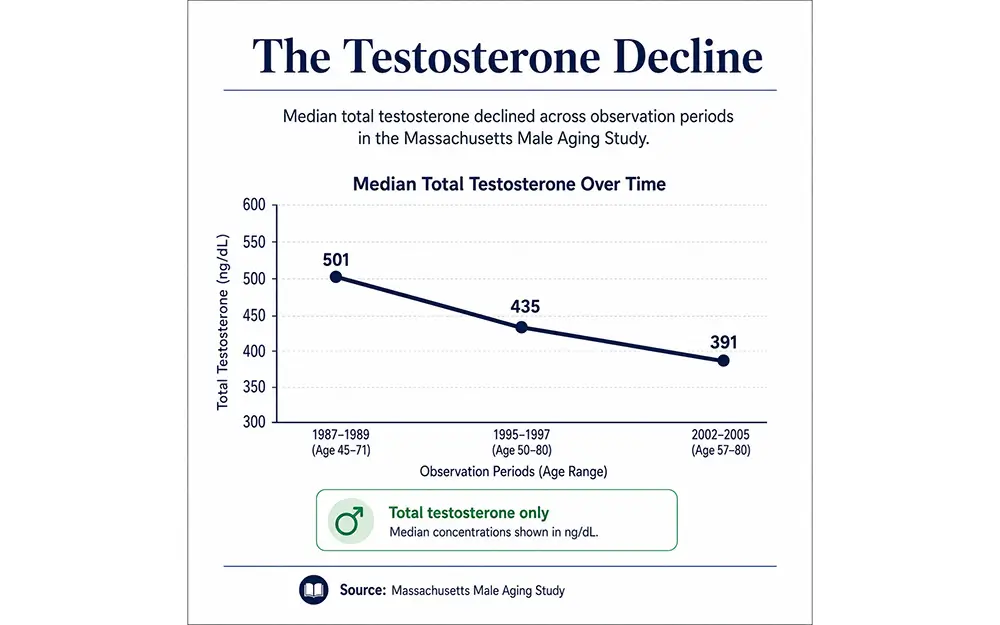
Additionally, the Massachusetts Male Aging Study found a raw decline of testosterone by ~22% between the 1980s and 2000s (3).
Sounds bad right?
It is.
But how much of the decline in testosterone is down to poor sleep?
We don't know for certain.
But 74% of UK workers report bad sleep quality (4), and only about a third of us get 7 to 8 hours a night (5).
The average is around 6.4 hours (5), and it's simply not enough. Especially for those wanting to perform at 100%.
And we're so conditioned to the symptoms of poor sleep that we don't even realise how much of an impact this is having on our lives.
Do any of these sound familiar?
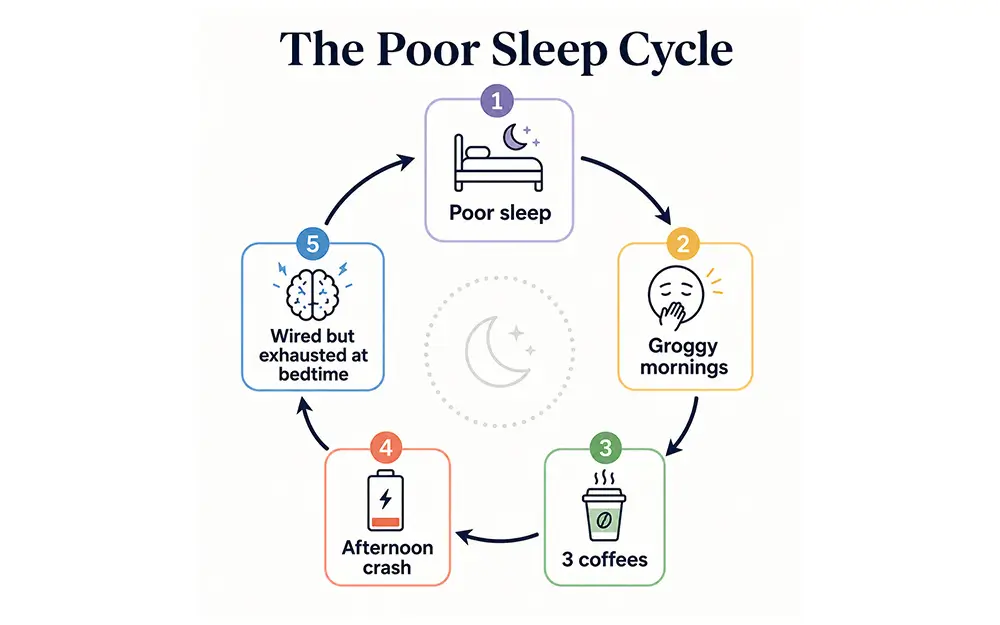
- Waking at 7am groggy, snoozing your alarm three times, slowly crawling out of bed wishing you could have just one more hour.
- Reaching for your fourth coffee by 2pm because your eyes are starting to feel heavy, and you can feel yourself taking longer to process what a colleague just said to you.
- Getting home exhausted and irritable, snapping at your partner and kids over nothing, only to regret it the next day.
None of this is normal.
If we charged our phone overnight, but it was capped at 40%, we'd say something was wrong.
But when we go to sleep and still wake up tired, we go straight for the coffee and don't even question it.
Most men assume this is just what getting older feels like, but don’t realise how much better they could be feeling if they slept better.
Even noticing you’re waking up with fewer morning erections can be a sign your testosterone is being affected.
In a study of 761 men, those who said they got night-time erections had average testosterone levels of 412 ng/dL, while those who didn’t averaged 303 ng/dL - around 26% lower (6).
Another study tracked the erections of 201 men overnight and found that those with the lowest testosterone levels had erections that were softer, less frequent, and didn’t last as long (7).
Now I don’t expect you to put a sensor ring around your private parts to actually track this - that’s Bryan Johnson territory.
And waking without one occasionally doesn’t automatically mean your testosterone is low.
But if you notice they’ve become consistently less frequent, especially alongside low libido, fatigue or problems getting erections, it can be a sign that something is off.
Low testosterone is also associated with poorer sleep quality and more night-time awakenings (8).
So poor sleep can lower testosterone, while lower testosterone may feed into the same downward spiral.
And the longer poor sleep is left, the worse it gets, as it raises your risk of obesity, diabetes, high blood pressure and depression (9).
Ultimately, we need to stop treating sleep as though it belongs at the bottom of our priority list.
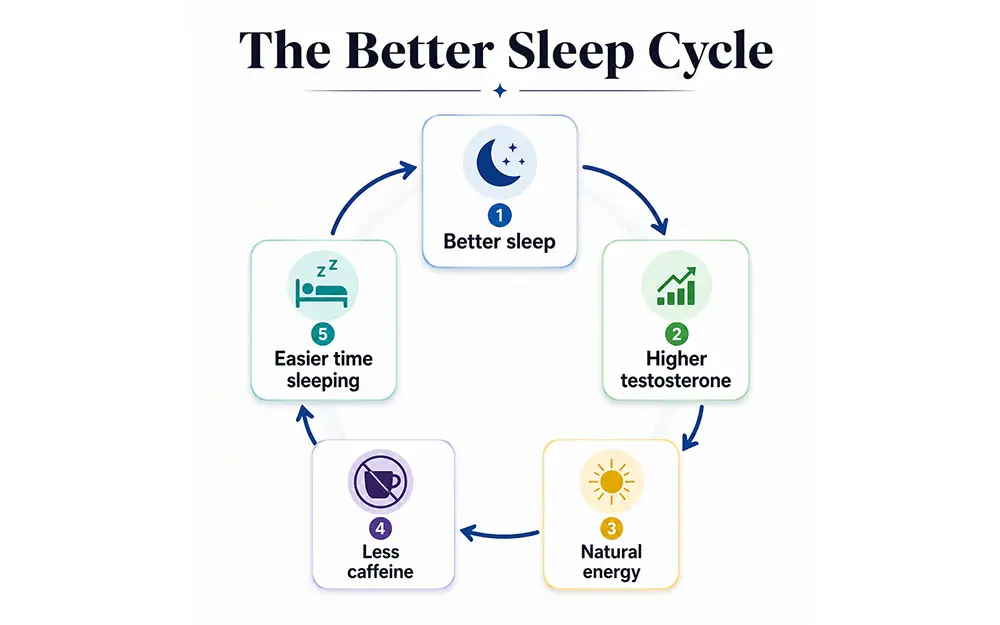
Instead, start treating it as the easiest lever you can pull to become the most driven, energised, highest-performing version of yourself.
The man who wakes at 5am full of energy, hits the gym, and has already smashed through two hours of focused work before anyone else is awake.
Being able to do that, instead of rolling out of bed barely functioning, gives you a serious advantage in all aspects of life.
So how do we get you there?
We need to break the poor sleep cycle and replace it with a better one:
But first, we need to understand why your sleep is poor in the first place.
There are 3 common issues I see that worsen sleep in the men I work with.
1. A mind that won't switch off
You've got a lot on your plate, and it feels never-ending.
Work and personal stressors keep popping up, making it extremely difficult to switch from ‘work mode’ into ‘sleep mode’.
You’re basically stuck putting out fires in your mind that aren’t even there.
That's the exact thing that has you lying there for over an hour, unable to relax or drop off no matter what you try.
The solution - close the book on the day.
Spend five minutes before bed getting everything out of your head and onto paper.
Anything that you find keeps coming up or is causing you stress.
Then, next to each one, write the single next action to solve this the next day - keep this simple and light, first step in the solution only.
You're telling your brain it doesn’t need to keep bringing it up because it’s accounted for and being dealt with.
That's what stops the 11pm mental replay of your entire day and looping thoughts about tomorrow’s tasks.
2. Waking at 3am wired
Stress and heightened arousal are common reasons for this.
When you’re carrying sustained stress, your body can remain overly alert at night. That leaves you wide awake at 3am as if you’ve just necked a double espresso.
You start tossing and turning, then check your phone to calculate how much sleep you could still get if you fell asleep immediately - only to become even more frustrated when you can’t.
The fix - meditation or breathwork.
People hear "breathwork" and picture a 60-year-old hippie with a long grey beard who hasn't showered in two years.
That's simply not the case.
Many high performers use breathwork to slow their heart rate, calm their mind and perform better under pressure.
Kobe Bryant, Billie Eilish and Liam Hemsworth have all spoken about using it.
Adding breathwork to your evening routine can reduce nighttime disruptions and make it easier to settle again if you do wake up.
3. Staying up to "get your own time back"
This one is about the choices you make before bed that reduce the amount of time you get to sleep.
When you're pulled from pillar to post 6am-6pm, it can feel like you never get a minute to yourself.
Work, family, exercise, repeat - no time to just chill.
So without realising it, you claim back that time to yourself by sacrificing sleep - lying in bed, scrolling Instagram, or watching "just one more episode" of Game of Thrones.
The fix - time blocking.
There's nothing wrong with mindlessly scrolling, watching Netflix, or playing video games - as long as it doesn’t take up hours on end.
It needs to be controlled.
With no time limit, one hour very easily turns into three.
So you have two options.
Option 1: Schedule 5 to 15 minutes of a relaxing activity you enjoy straight after your intense work blocks in the day.
Having that time earlier makes you far less likely to want to do it at 11pm, so you get to bed earlier and then get more sleep.
Option 2: Keep the activity in the evening, but set a strict time limit and set an alarm for when it's done.
This stops you going down a rabbit hole, checking the time, then realising you’ve only got 7 hours in bed (which isn’t the same as 7 hours asleep, because you naturally spend time awake at night)
So you end up with less than you need to feel and perform at your best.
Remember, sleep is one of the biggest factors supporting healthy testosterone production.
If you neglect it, you’ll spend years wondering why you feel older than you are.
If you prioritise it, you'll perform closer to the level you're actually capable of.
References
- Rojas-Zambrano JG, Rojas-Zambrano AR, Rojas-Zambrano AF, Barahona-Cueva GE. Benefits of testosterone hormone in the human body: a systematic review. Cureus. 2025;17(2):e78785.
- Leproult R, Van Cauter E. Effect of 1 week of sleep restriction on testosterone levels in young healthy men. JAMA. 2011;305(21):2173–2174.
- Travison TG, Araujo AB, O’Donnell AB, Kupelian V, McKinlay JB. A population-level decline in serum testosterone levels in American men. J Clin Endocrinol Metab. 2007;92(1):196–202.
- Work in Mind. Workplace survey of 8,000 UK workers finds 74% of adults report bad sleep quality. 2022. Available from: https://workinmind.org/2022/09/28/workplace-survey-of-8000-uk-workers-finds-74-of-adults-report-bad-sleep-quality/
- Curaleaf Clinic. Britain’s sleep crisis: the hidden cost of 22 billion lost hours. Available from: https://curaleafclinic.com/news/britains-sleep-crisis/
- Andrews J, Ziegelmann M, Wymer K, Avant R, Bole R, Trost L. Nocturnal erections are an accurate predictor of overall erectile function, libido and testosterone levels. J Sex Med. 2019;16(4 Suppl 1):S94–S95. doi:10.1016/j.jsxm.2019.01.199.
- Granata ARM, Rochira V, Lerchl A, Marrama P, Carani C. Relationship between sleep-related erections and testosterone levels in men. J Androl. 1997;18(5):522–527.
- Barrett-Connor E, Dam TT, Stone K, Harrison SL, Redline S, Orwoll E; Osteoporotic Fractures in Men Study Group. The association of testosterone levels with overall sleep quality, sleep architecture, and sleep-disordered breathing. J Clin Endocrinol Metab. 2008;93(7):2602–2609.
- Watson NF, Badr MS, Belenky G, et al. Recommended amount of sleep for a healthy adult: a joint consensus recommendation of the American Academy of Sleep Medicine and Sleep Research Society. Sleep. 2015;38(6):843–844.
About our Team
Chester Maglo (BSc, MSc) is an NHS Respiratory and Sleep Scientist and performance coach who bridges the gap between clinical science and high performance to help business owners unlock peak energy and recovery.
Related Articles


Sales Enquiries
Mon-Sat: 09:30am - 5:30pm
Sunday: 10am - 4pm
Customer Service
Mon-Sat: 09:30am - 5:30pm
Sunday: Closed
customerservice@mattressonline.co.uk