

How Much Is Poor Sleep Affecting Your Gym Performance?


One night of poor sleep can reduce your physical performance (strength, sprint speed, anaerobic power, endurance and more) by an average of 7.56%.
That's from a review of 69 research studies (1).
There are 11.3 million gym members in the UK, about 16.6% of us (2).
Plenty have bought some form of supplement to gain an edge: whey protein, creatine, pre-workout.
Sure, they can provide a minor benefit, but poor sleep can take away a similar amount of performance, or more.
Table 1: The benefits of popular performance supplements vs how poor sleep counteracts them
| Supplement | Why people take it | What it adds | What poor sleep takes away |
| Whey protein | To build muscle | 0.3kg more fat-free mass over 6+ weeks of training (3) | 0.9kg more fat-free mass lost in 2 weeks of dieting on 5.5 hours in bed instead of 8.5 (4) |
| Creatine | To get more reps | 14% more reps at a set weight than training without it (5) | 9.85% fewer reps at a set weight after 1 bad night (1) |
| Caffeine | To lift heavier | Around 7% more strength, but only in the quads (6) | 4.58% less strength in the afternoon after 1 bad night (1) |
It's not a perfect like-for-like comparison, as some of these studies have a small number of participants, and this compares only short-term impacts of poor sleep.
The point is, you don't need a list of supplements for the results you want. You simply need to prioritise getting better sleep.
How does 1 bad night impact next-day performance?
Strength has been shown to drop 1.78% in the morning, not bad.
But by the afternoon it's down 4.58%. So the longer the day goes on, the worse it gets (1).
Power (think sprints and jumps) was down 6.26% (1).
The bigger issue was that coordination, accuracy and timing dropped 14.2% in the morning and 22.9% in the afternoon (1).
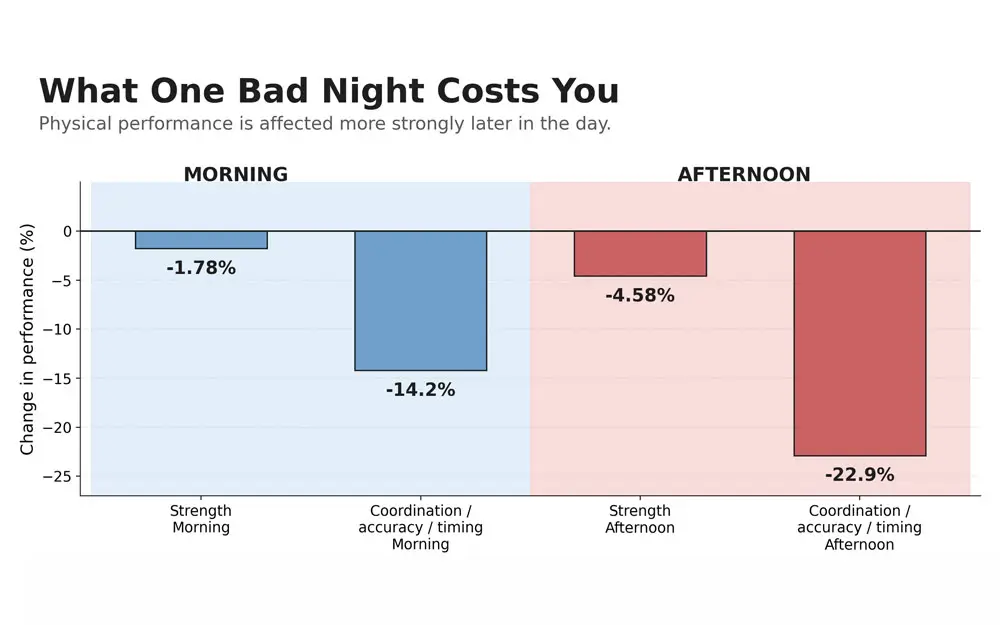
So after a bad night, training in the morning may be the better option if you want to minimise the negative impacts.
Another issue is how sleep affects your body's ability to build muscle from protein you eat.
Researchers put 13 healthy young adults through one night of total sleep deprivation and one night of normal sleep.
They found that muscle protein synthesis dropped by 18%, testosterone dropped by 24%, and cortisol increased by 21% (7).
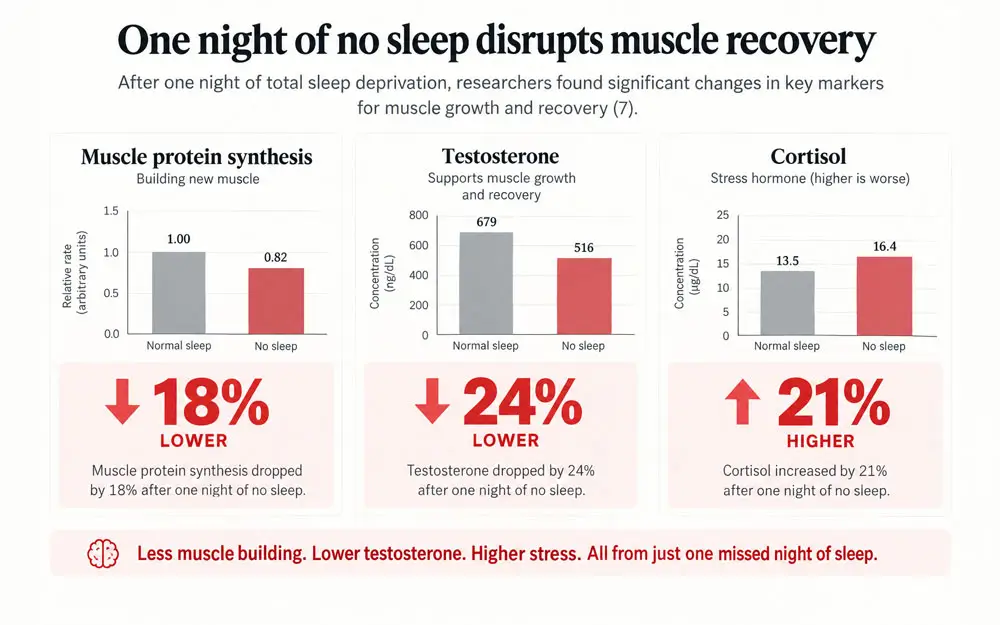
This was after a full night of no sleep, so it's an extreme scenario, but it shows how much sleep affects your ability to build muscle and your stress levels.
Training in the gym is like ordering bricks to build a house.
Sleep is like hiring builders to put it all together.
You might have 4 people instead of 5. So the house will still be built, but it'll be slower and less effective.
What about injuries?
You'll see "sleep less, get injured more" quoted everywhere. Everyone who says this looks at the same study, but they never look at the finer details.
The study surveyed 112 adolescent athletes. The ones sleeping under 8 hours a night were 1.7x more likely to have been injured (8).
This may just mean they were already injured and slept badly as a result. We don't know which came first (chicken and egg situation).
However, for those who push hard in the gym, I'm talking about those last reps on a squat where you feel like you're squeezing every part of your body as hard as you can, but the rep is moving at 0.2x speed.
Those are the reps that can get you injured, and a 14-23% drop in coordination could make them riskier, as you have less control over what your body does.
Cut your damn coffee back
Everyone loves coffee, and I get it, so do I.
I'll happily take a large Americano from Costa most days.
But if I have more than 1, or if it's any later than 11am, I can't sleep.
A study of 12 people showed that 400mg of caffeine taken 6 hours before bed cut total sleep time by more than an hour (9).
So when it's 6pm, you've had a long day at work and want a "boost" for a good session, you're actively cutting into your sleep and slowing the progression.
And realistically, if you just stopped telling yourself that you "need it", you'd drag yourself there and feel instantly motivated as soon as you get past exercise 1 anyway.
Training late is fine (despite popular belief)
A 2019 review of 23 studies found that evening exercise didn't disrupt sleep when it finished more than an hour before bed. It actually slightly increased deep sleep (10).
But in 2025 a study of 14,689 people wearing WHOOP devices showed that the later and harder the session, the later people fell asleep, the less sleep they got, and the higher their heart rate stayed all night. Sessions finishing 4 or more hours before sleep showed no effect at all (11).
Problem is, everyone in the study wore a WHOOP, and people who track their sleep can be more prone to overthinking it.
2 of the 10 researchers also work for WHOOP, so take it with a pinch of salt.
In my experience working with high performers, the guilt of not training would likely impact sleep more than a slightly elevated heart rate would.
So if you can only get a session in late, get it done anyway.
How do you know when to push and when to back off?
9 out of 10 times, I would tell people to train after 1 poor night of sleep.
The human body is very resilient. As long as you don't get in your head, overthink it and tell yourself you'll have a bad session, you'll be fine.
3+ bad nights in a row is a bit of a different situation.
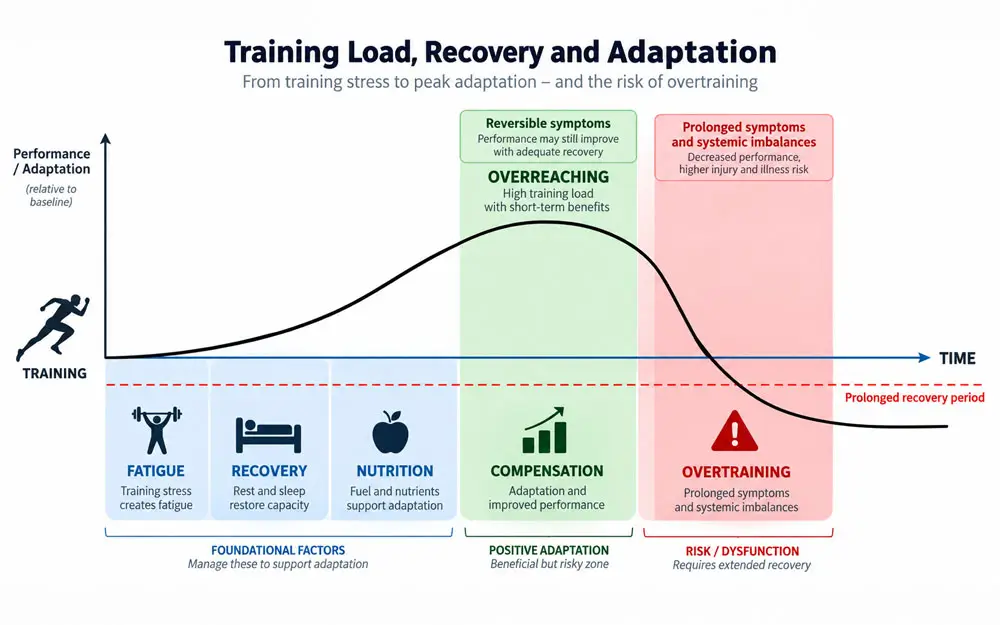
It can signal that your body isn't recovering properly or is in a heightened stress state.
I think of this as though you've stepped in a shallow sandpit on the beach - very easy to get out of with minimal effort.
Pushing through this can turn it into quicksand, which drags you 10 feet deeper and takes far longer to claw your way out of.
So back off for a few days and get your sleep sorted before you go heavy again.
What about fitness trackers?
With all the data from WHOOP, Oura, Apple Watch and Garmin, everyone is looking for signs to tell them when they can push harder or when they need to take a break.
A review of 8 studies compared people who adjusted their training based on their heart rate variability (HRV) with people who just followed a set plan (12).
The HRV group showed some improvements in submaximal physiological markers, but there was no real difference in actual performance or VO2 max.
And every one of those studies was on endurance training rather than resistance training.
So usually, all you need is to eat right, sleep well, track your progress, and try to improve each week.
Sleep is the greatest performance lever
In 2011, researchers at Stanford asked 11 basketball players to spend at least 10 hours in bed every night for 5 to 7 weeks (13).
Their sprint times dropped from 16.2 seconds to 15.5, and their free throws and three-pointers improved by 9% and 9.2%, respectively (13).
They also cut out caffeine and alcohol during the study, and there was no comparison group, so we can't be sure how much of that was down to the extra sleep.
I'm not asking you to spend 10 hours in bed either, but an extra 30 to 45 minutes a night is realistic for most men, and it adds up fast over a training block.
Sort your sleep before you spend another penny on supplements.
Otherwise, you'll keep trying to fill a bucket that's constantly leaking.
References
- Craven J, McCartney D, Desbrow B, Sabapathy S, Bellinger P, Roberts L, Irwin C. Effects of acute sleep loss on physical performance: a systematic and meta-analytical review. Sports Med. 2022;52(11):2669-2690.
- Leisure DB. State of the UK Fitness Industry Report 2025. Leisure DB; 2025.
- Morton RW, Murphy KT, McKellar SR, Schoenfeld BJ, Henselmans M, Helms E, Aragon AA, Devries MC, Banfield L, Krieger JW, Phillips SM. A systematic review, meta-analysis and meta-regression of the effect of protein supplementation on resistance training-induced gains in muscle mass and strength in healthy adults. Br J Sports Med. 2018;52(6):376-384.
- Nedeltcheva AV, Kilkus JM, Imperial J, Schoeller DA, Penev PD. Insufficient sleep undermines dietary efforts to reduce adiposity. Ann Intern Med. 2010;153(7):435-441.
- Rawson ES, Volek JS. Effects of creatine supplementation and resistance training on muscle strength and weightlifting performance. J Strength Cond Res. 2003;17(4):822-831.
- Warren GL, Park ND, Maresca RD, McKibans KI, Millard-Stafford ML. Effect of caffeine ingestion on muscular strength and endurance: a meta-analysis. Med Sci Sports Exerc. 2010;42(7):1375-1387.
- Lamon S, Morabito A, Arentson-Lantz E, Knowles O, Vincent GE, Condo D, Alexander SE, Garnham A, Paddon-Jones D, Aisbett B. The effect of acute sleep deprivation on skeletal muscle protein synthesis and the hormonal environment. Physiol Rep. 2021;9(1):e14660.
- Milewski MD, Skaggs DL, Bishop GA, Pace JL, Ibrahim DA, Wren TAL, Barzdukas A. Chronic lack of sleep is associated with increased sports injuries in adolescent athletes. J Pediatr Orthop. 2014;34(2):129-133.
- Drake C, Roehrs T, Shambroom J, Roth T. Caffeine effects on sleep taken 0, 3, or 6 hours before going to bed. J Clin Sleep Med. 2013;9(11):1195-1200.
- Stutz J, Eiholzer R, Spengler CM. Effects of evening exercise on sleep in healthy participants: a systematic review and meta-analysis. Sports Med. 2019;49(2):269-287.
- Leota J, Presby DM, Le F, Czeisler ME, Mascaro L, Capodilupo ER, Wiley JF, Drummond SPA, Rajaratnam SMW, Facer-Childs ER. Dose-response relationship between evening exercise and sleep. Nat Commun. 2025;16:3297.
- Düking P, Zinner C, Trabelsi K, Reed JL, Holmberg HC, Kunz P, Sperlich B. Monitoring and adapting endurance training on the basis of heart rate variability monitored by wearable technologies: a systematic review with meta-analysis. J Sci Med Sport. 2021;24(11):1180-1192.
- Mah CD, Mah KE, Kezirian EJ, Dement WC. The effects of sleep extension on the athletic performance of collegiate basketball players. Sleep. 2011;34(7):943-950.
About our Team
Chester Maglo (BSc, MSc) is an NHS Respiratory and Sleep Scientist and performance coach who bridges the gap between clinical science and high performance to help business owners unlock peak energy and recovery.
Related Articles
Sales Enquiries
Mon-Sat: 09:30am - 5:30pm
Sunday: 10am - 4pm
Customer Service
Mon-Sat: 09:30am - 5:30pm
Sunday: Closed
customerservice@mattressonline.co.uk


