

Can sleep help weight loss medication?


Not sleeping enough can make weight loss significantly harder.
And neither Mounjaro nor Ozempic can magically cancel this out.
A study found that people with poor sleep quality had 29% higher odds of being obese than those reporting good-quality sleep (1).
And those sleeping less than five hours had 55% higher odds of obesity (2).
Finally, a study involving more than 150,000 adults found that short sleepers had around 41% higher odds of becoming obese in the future (3).
Importantly, this doesn't mean less sleep automatically makes you fat. But it does make it harder for you to lose weight and easier to put it on.
One reason is that your appetite regulation gets disrupted when you don't sleep enough (4).
Ghrelin can increase (the hormone that makes you hungry).
Leptin can decrease (the hormone that helps keep you full).
Ghrelin has been shown as higher in people who sleep less (4).
When your stomach is empty, Ghrelin increases until it peaks right before you have another meal.
This gets you thinking about whether you're going to have lasagne or bolognese for dinner.
Leptin is produced by your fat cells and tells your brain that you've gotten enough fuel from food so you no longer need to keep eating.
Almost like when you can't fill your car up with any more petrol because the pump clicks off.
The only difference is, this signal can be less effective when sleep is worse. Meaning you can keep filling the tank up, even when the fuel gauge is at maximum.
In one study, 12 healthy young men spent two nights in bed for 4 hours, then two nights in bed for 10 hours. After the short nights, leptin fell by 18% and the ratio of ghrelin to leptin increased by 71% (5).
Also, their appetite for sweets, biscuits and cake spiked, while their appetite for fruit, vegetables and dairy barely changed (5).
Another study of 1,024 adults found habitually sleeping 5 hours a night was associated with 15.5% lower leptin and 14.9% higher ghrelin compared to sleeping 8 hours (6).
Meaning hormones skewed in favour of being hungry compared to full, and this has been shown in eating patterns.
In one small study, people restricted to around 5.2 hours of sleep ate 559 extra calories per day compared with their own baseline intake (7).
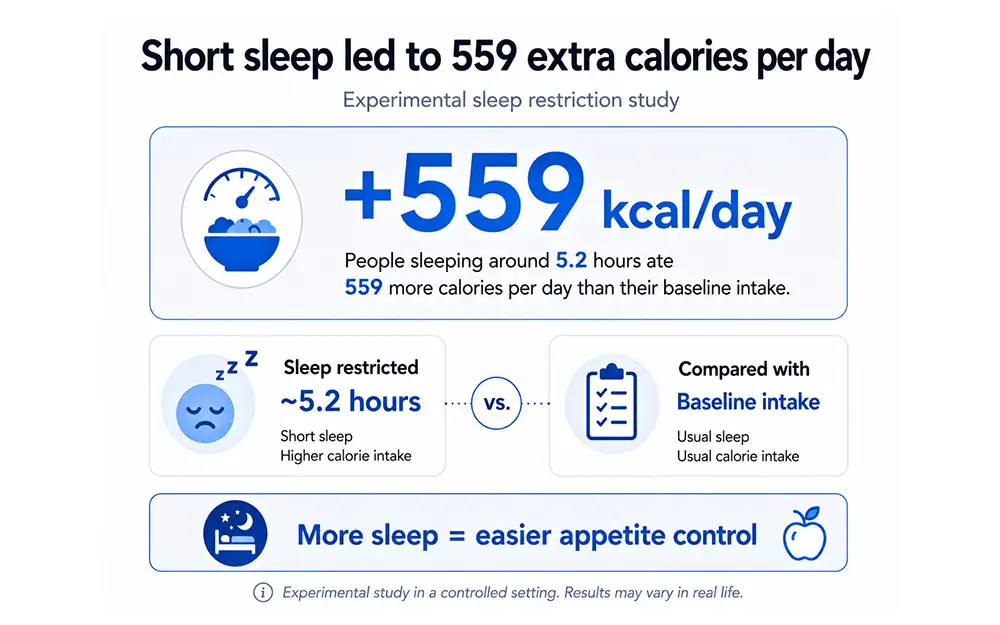
So you eat more, and worse, when you sleep less.
It's starting to sound like a good night's sleep is one of the most powerful things we can do to make weight loss far easier.
In fact, sufficient sleep quality and duration have been associated with a 33% greater likelihood of weight-loss success (8), and can increase the proportion of weight lost from fat rather than fat-free mass, including muscle, while the opposite is also true (9).
The exact reason why more fat-free mass is lost due to poor sleep isn't completely clear. But reduced testosterone and increased cortisol may play a role (10).
So how do GLP-1 medications fit into this picture?
GLP-1 is a hormone your gut releases after eating to tell your brain you've had enough to eat. After a night without sleep, the GLP-1 response to breakfast was shown to be delayed by around 90 minutes in 12 healthy men (11).
So if you consistently sleep poorly while taking Ozempic or Mounjaro, you're working against the pathway the medication is working on.
Regardless, GLP-1 medications have been shown to be very effective, producing at least some weight loss in around 79% of people in a meta-analysis involving 7,024 participants (12).
However, another study following 367 people taking GLP-1 medications found that 83% of those sleeping more than six hours had lost at least 3% of their body weight, while only 64% of those sleeping less than six hours met this same target (13).
Around a 30% higher success rate when GLP-1s were combined with sufficient sleep.
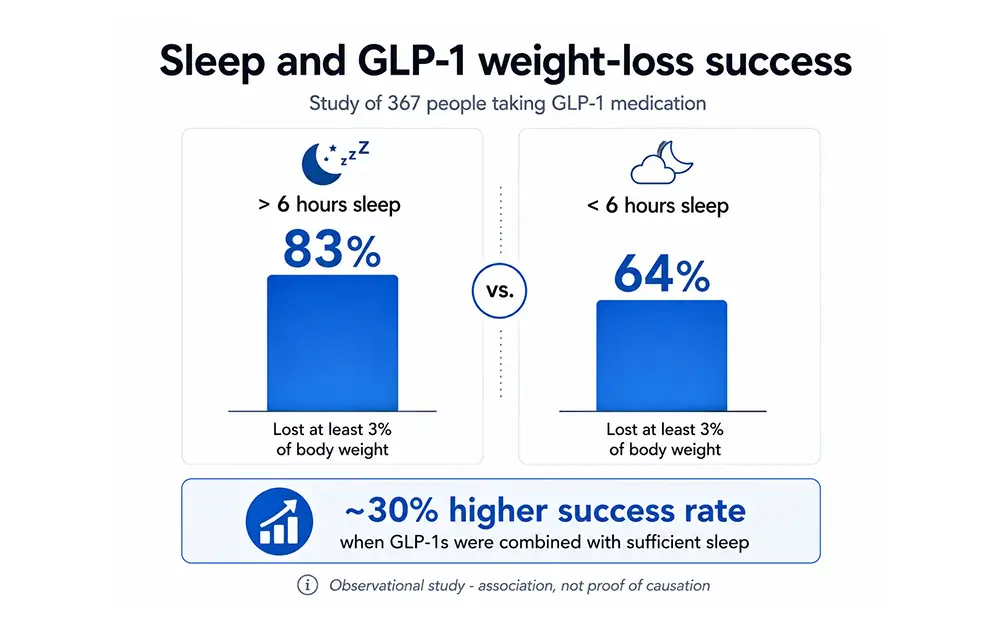
This isn't hard proof, but it does start to paint a picture.
Are GLP-1s effective without thinking of anything else?
Yes.
Can they be more effective with better sleep?
Highly likely.
One problem with focusing on GLP-1s alone to support weight loss is what happens after you stop taking them?
A 2026 meta-analysis involving 9,341 people found that, on average, people were projected to return to their starting weight around 1.5 to 1.7 years after stopping, gaining back 0.4 to 0.8 kg every month (14).
It's great if you lose weight. But putting it back on after you lose it makes the whole approach seem a little pointless to me.
Getting to a healthy weight shouldn't be a yo-yo approach.
It should be a one time thing you achieve, that you sustain for the rest of your life.
So if you just take GLP-1 medications, but never focus on following a healthy lifestyle, your success can be taken away like it never happened to begin with.
Almost like a henna tattoo you got when you were 16 years old.
Great while it lasted, and you could show it off at the time, but it was never permanent.
So are GLP-1s a good or bad thing?
My view is that in most cases they're a quick fix, and a quick fix isn't the same as better health.
They are very effective at helping you lose weight, because they suppress your appetite.
But unless you work on learning the habits that actually lead to sustainable weight loss, the weight is likely to come back on once you stop.
And when weight loss is easy, you have no reason to sleep better, eat healthier or exercise more.
Because why would you, the medication is doing the work for you.
The exact reason why these work, is the exact reason they fail in the long-term, unless you're taking them for life.
But considering they start at around £144 a month privately (15), that's at least £864 across six months, and the price goes up as your dose does.
In my opinion, that's much better spent on a PT or Nutritionist, who will help you lose weight (that you can actually keep off), increase your energy, increase your strength, help you age healthily, and hold you to a standard you can be proud of.
You can hit the weight you used to be 20 years ago, while saying to yourself:
"That was all me"
Which quite frankly, is a much better feeling than taking the easy option of a quick fix medication.
None of this is medical advice, and if you're taking a GLP-1 under medical supervision because you meet the medical criteria, that's a conversation for you and your doctor.
However, sleep regulates your appetite, so get this sorted and you'll have an easier time losing weight, and will be able to spring out of bed with your battery fully charged.
It's the most effective natural weight loss tool you have available, and it's completely free.
References:
- Sleep duration, sleep quality and the risk of being obese: Evidence from the Australian panel survey
- Sleep and obesity
- Sleep duration and obesity in adulthood: An updated systematic review and meta-analysis
- Associations of short sleep duration with appetite-regulating hormones and adipokines: A systematic review and meta-analysis
- Brief communication: Sleep curtailment in healthy young men is associated with decreased leptin levels, elevated ghrelin levels, and increased hunger and appetite. Annals of Internal Medicine, 2004
- Short sleep duration is associated with reduced leptin, elevated ghrelin, and increased body mass index. PLoS Medicine, 2004
- Effects of Experimental Sleep Restriction on Caloric Intake and Activity Energy Expenditure
- Sleep Deprivation: Effects on Weight Loss and Weight Loss Maintenance
- Influence of sleep restriction on weight loss outcomes associated with caloric restriction
- Effect of changes in sleeping behaviour on skeletal muscle and fat mass: A retrospective cohort study
- Acute sleep deprivation delays the glucagon-like peptide 1 peak response to breakfast in healthy men. Nutrition & Diabetes, 2013
- GLP-1 receptor agonists for weight loss: A systematic review and meta-analysis of randomised controlled trials
- Impact of Sleeping Habits on the Weight Loss Effect of Oral Glucagon-Like Peptide-1 Receptor Agonists Among Obese Patients: An Observational Study in Japan
- Weight regain after cessation of medication for weight management: Systematic review and meta-analysis
- Voy. Weight loss treatment pricing. Available from: https://hello.joinvoy.com/wl-weg-pmax-sale (accessed 9 August 2026)
About our Team
Chester Maglo (BSc, MSc) is an NHS Respiratory and Sleep Scientist and performance coach who bridges the gap between clinical science and high performance to help business owners unlock peak energy and recovery.
Related Articles

Sales Enquiries
Mon-Sat: 09:30am - 5:30pm
Sunday: 10am - 4pm
Customer Service
Mon-Sat: 09:30am - 5:30pm
Sunday: Closed
customerservice@mattressonline.co.uk