
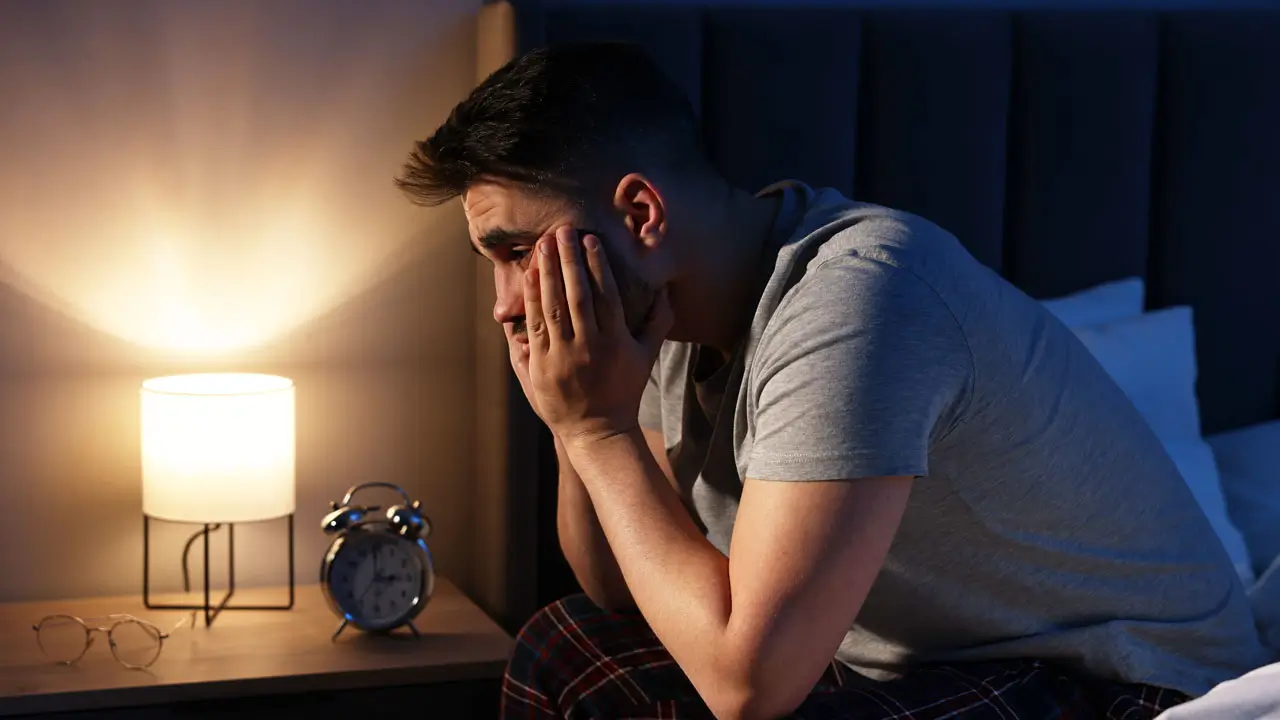


Nearly half of all men wake up at least once a night to use the toilet(1).
That's from the EPIC study, which interviewed 19,165 adults across 5 countries, including the UK. Nocturia (waking at night to urinate) was the most common urinary symptom in men, at 48.6% (1).
And if you've been up in the night more than once because of this, you know how bloody annoying it is.
But why is it always 3am?
You get the majority of your deep sleep in the first half of the night. During this stage of sleep, you're much harder to wake.
So if you go to bed at 10pm, by around 3am you're moving into the second half of the night, when deep sleep is much less prominent.
And this only gets worse as you get older.
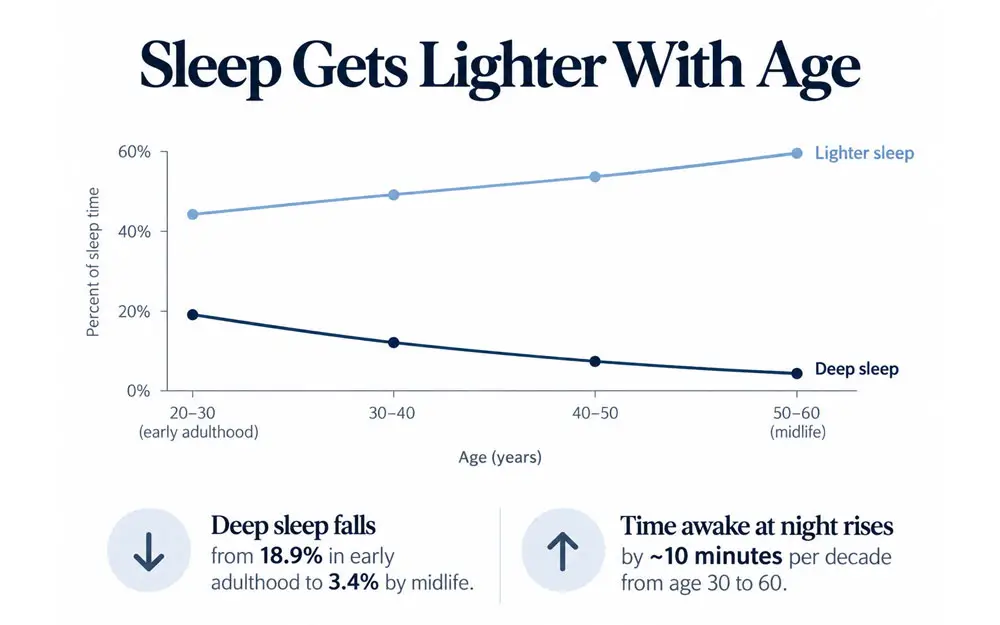
In a study of 149 healthy men aged 16 to 83, deep sleep fell from 18.9% of the night in early adulthood to 3.4% by ages 36 to 50, replaced by lighter sleep(2).
That's a stark contrast, and it's a natural part of ageing.
A meta-analysis of 65 studies covering 3,577 people found that time spent awake at night climbs by around 10 minutes per decade between 30 and 60(3).
At 20, you could've probably slept through an earthquake.
At 50, even the mosquito in the corner of your room could wake you.
Not to mention your wife getting back into bed, baby crying, or the living room door slamming shut downstairs.
How much of an impact does your prostate have?
In an analysis of more than 1,000 prostates, benign prostatic hyperplasia (a non-cancerous enlargement) was present in 8% of men in their thirties and 50% of men aged 51 to 60(4).
A bigger prostate makes it harder to empty the bladder fully, so it fills again sooner.
However, this may not be the primary cause (though it may contribute).
When researchers used bladder diaries to measure what was actually happening in 875 Japanese patients who came in complaining of waking up to pee, 67.4% turned out to have nocturnal polyuria.
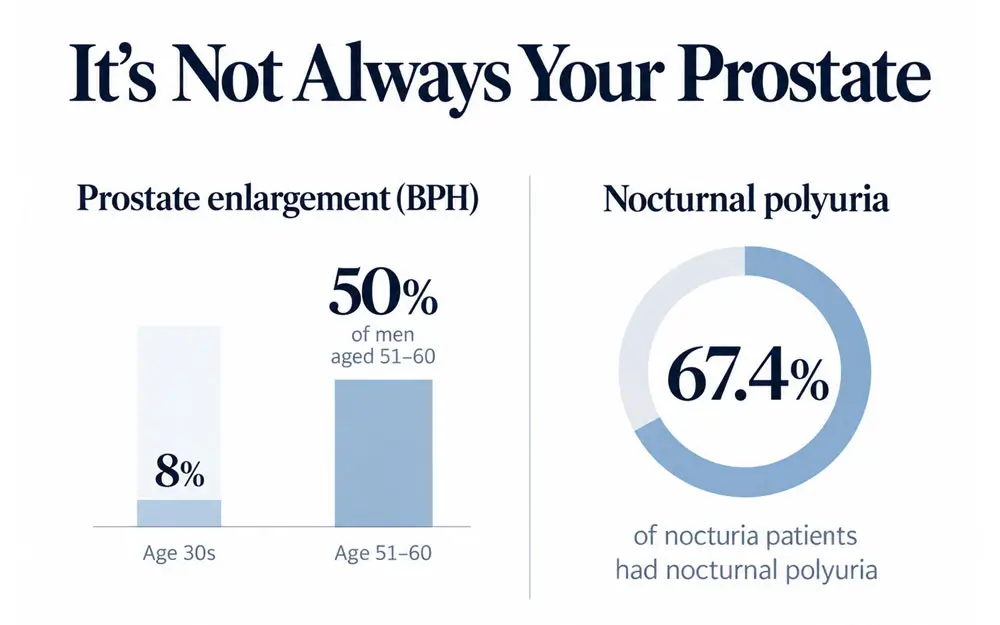
Meaning their bodies were simply producing too much urine overnight(5).
But if we know that a cause can be that your body simply produces too much urine, then 2 things are worth paying attention to:
How much water you're drinking.
When you finish drinking water.
What about your late night guinness?
A review of every available study on alcohol and sleep in healthy volunteers found that you fall asleep faster, get more deep sleep in the first half of the night, and the second half is more disrupted(6).
Alcohol is a sedative, but it wears off after you're asleep - usually at the point where your sleep is the lightest.
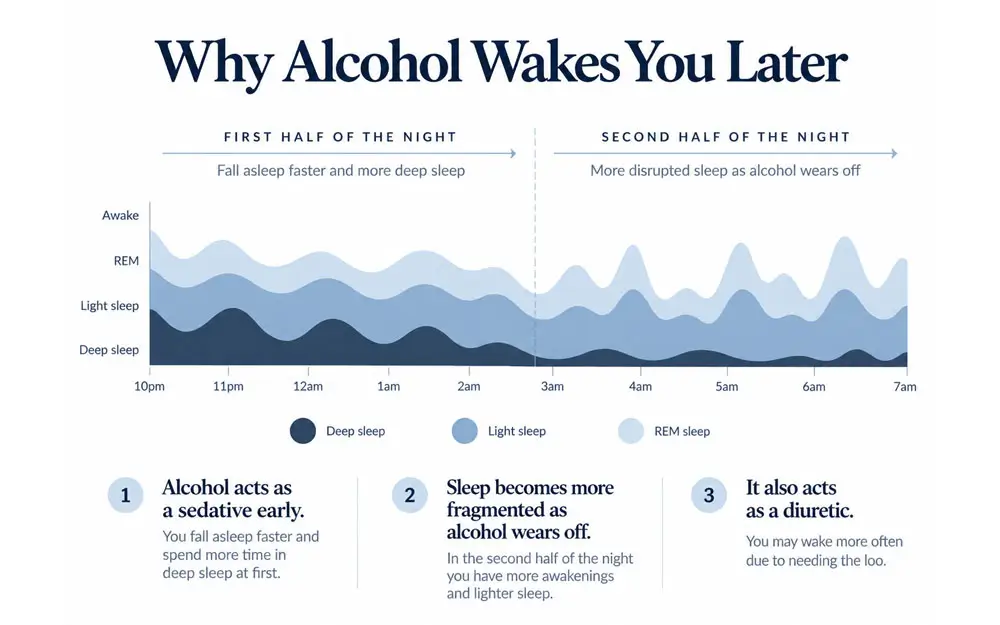
It's also a diuretic, so you'll likely be taking a trip to the loo with a banging headache - tripping over your feet if you had one too many.
I'm not going to tell you to stop drinking, because I don't think that's an approach that most would want to commit to.
But if you're waking at 3am after 1-2 drinks, now you know why.
Ultimately, it's a tradeoff.
Have an occasional drink, but accept that sleep will likely be worse that night.
One of my clients logged every night for 8 weeks, 56 nights in total. He had 5 nights that stood out as worse than the others when he rated how well he thought he slept.
60% of those poor nights were after he drank. His worst night awake was 1h 45m after 2 glasses of red wine.
I snore, is that having an effect?
Snoring itself - probably not.
But it can be a sign of a condition called sleep apnoea, when you periodically stop breathing in your sleep.
The British Lung Foundation estimated around 1.5 million UK adults had it in 2014(7). The Sleep Apnoea Trust estimates as many as 4 million have moderate or severe apnoea(8).
But most of them have no idea.
In a study of 4,925 adults, with overnight sleep studies on 1,090 of them, 82% of the men with moderate to severe sleep apnoea had never been diagnosed(9).
And middle-aged men are at higher risk than most.
Moderate to severe sleep-disordered breathing is estimated to affect 10% of men aged 30 to 49 and 17% of men aged 50 to 70(10).
Among 274 patients starting treatment for sleep apnoea, 76.4% were waking at least once a night to urinate.
After treatment, the proportion getting up twice or more dropped from 73.0% to 51.5%(11).
So you might not simply be waking because your bladder is full. Sleep apnoea can wake you repeatedly and can also contribute to producing more urine overnight(12).
You were asleep, so you wouldn’t know what caused it.
But if you're snoring heavily, waking up gasping, or feeling wiped out all day despite 8 hours in bed - that's a clear sign you should speak to your GP.
You can always ask your partner if they notice any of these issues, and here's a tool you can use to check your risk for sleep apnoea:
https://www.mdcalc.com/calc/3992/stop-bang-score-obstructive-sleep-apnea
Why can't you always fall back asleep?
2 common reasons.
Something is stressing you out.
Meaning your brain is switched on and racing from the minute your eyes open.
You checked the clock.
Now your brain has gone down a mathematical rabbit hole - counting down the hours you have left until you're up.
Waking briefly in the night is normal, but lying there for 40 minutes can make you feel tired and have brain fog the next day.
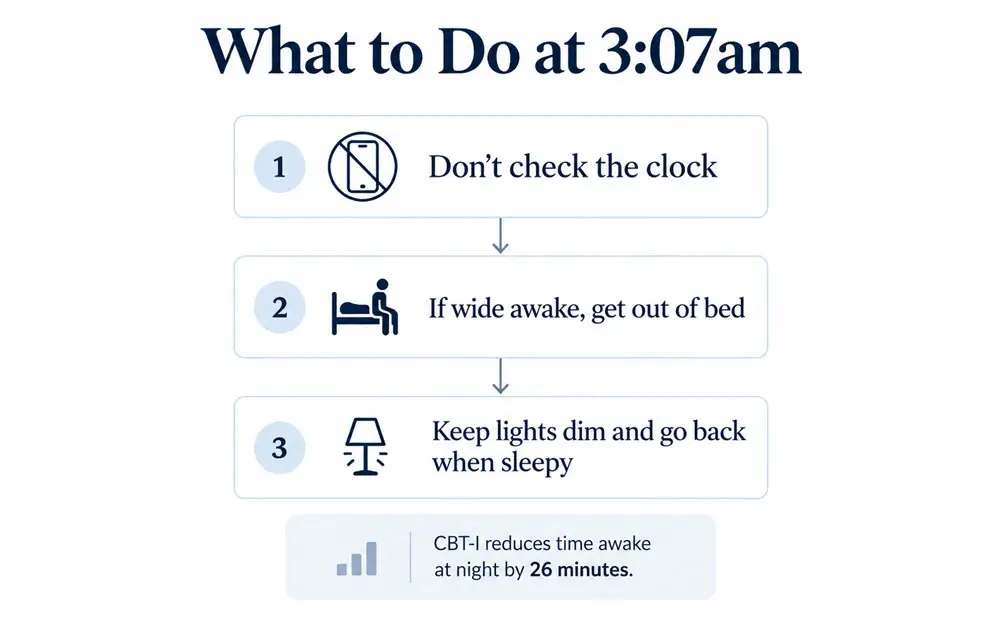
So what to actually do if you wake at 3:07am?
- Stop looking at the clock.
A study took 30 good sleepers and 30 poor sleepers and instructed them either to watch a clock while trying to fall asleep or not to look at one.
The clock watchers for both good sleepers and poor sleepers worried more and took longer to fall asleep(13).
Your phone is your clock. So either limit screen time overnight in the settings or leave it out of your room.
It just switches your brain on, which is exactly what you want to avoid when you're trying to fall back asleep quickly.
- If you're wide awake and getting frustrated, just get out of bed.
The more time you spend awake in bed, thinking, scrolling or swearing at the fact you can't sleep, the worse it gets.
The more you do that, the more you train your brain to think it's normal.
You need to teach your brain that your bed is for sleep only.
Keep the lights dim, do something boring that helps you relax, and go back when you're genuinely sleepy.
Across 20 randomised trials of cognitive behavioural therapy for insomnia built on rules like this one, time spent awake at night fell by 26 minutes(14).
3. Finish drinking earlier.
If you finish drinking by 7pm, go to bed at 10pm, and still wake up to pee, this may be a sign you should see a GP.
Waking up once is fairly normal, but waking more than that despite such a gap between finishing drinking and going to bed may suggest there's a different issue causing it.
What to do now?
At my worst, I woke up 7 times in one night, and hadn't slept through fully for around 3 years.
It felt hopeless at the time.
It wasn't until I did this exercise and experimented with different things that I started getting nights where I felt like my head hit the pillow and it was morning.
Then I woke up with a spring in my step, plus the motivation and energy to crush the rest of the day.
And once you know the root cause, you can finally take the correct actions to achieve this for yourself.
References
- Irwin DE, Milsom I, Hunskaar S, Reilly K, Kopp Z, Herschorn S, Coyne K, Kelleher C, Hampel C, Artibani W, Abrams P. Population-based survey of urinary incontinence, overactive bladder, and other lower urinary tract symptoms in five countries: results of the EPIC study. Eur Urol. 2006;50(6):1306-1314.
- Van Cauter E, Leproult R, Plat L. Age-related changes in slow wave sleep and REM sleep and relationship with growth hormone and cortisol levels in healthy men. JAMA. 2000;284(7):861-868.
- Ohayon MM, Carskadon MA, Guilleminault C, Vitiello MV. Meta-analysis of quantitative sleep parameters from childhood to old age in healthy individuals: developing normative sleep values across the human lifespan. Sleep. 2004;27(7):1255-1273.
- Berry SJ, Coffey DS, Walsh PC, Ewing LL. The development of human benign prostatic hyperplasia with age. J Urol. 1984;132(3):474-479.
- Iinuma K, Nishino Y, Matsuoka K, Ihara T, Makabe S, Tanji R, et al. The prevalence and predictive factors of nocturnal polyuria in Japanese patients with nocturia: a multicentral retrospective cohort study. Sci Rep. 2023;13:18128.
- Ebrahim IO, Shapiro CM, Williams AJ, Fenwick PB. Alcohol and sleep I: effects on normal sleep. Alcohol Clin Exp Res. 2013;37(4):539-549.
- OHE Consulting. Obstructive sleep apnoea health economics report. London: British Lung Foundation; 2014.
- Sleep Apnoea Trust Association. Research: prevalence of obstructive sleep apnoea in the UK. Available from: https://sleep-apnoea-trust.org/research/ (accessed 23 September 2026).
- Young T, Evans L, Finn L, Palta M. Estimation of the clinically diagnosed proportion of sleep apnea syndrome in middle-aged men and women. Sleep. 1997;20(9):705-706.
- Peppard PE, Young T, Barnet JH, Palta M, Hagen EW, Hla KM. Increased prevalence of sleep-disordered breathing in adults. Am J Epidemiol. 2013;177(9):1006-1014.
- Vrooman OPJ, van Balken MR, van Koeveringe GA, van Kerrebroeck PVA, Driessen LEMJ, Schouten LJ, Rahnama'i MS. The effect of continuous positive airway pressure on nocturia in patients with obstructive sleep apnea syndrome. Neurourol Urodyn. 2020;39(4):1124-1128.
- Umlauf MG, Chasens ER. Sleep disordered breathing and nocturnal polyuria: nocturia and enuresis. Sleep Med Rev. 2003;7(5):403-411.
- Tang NK, Anne Schmidt D, Harvey AG. Sleeping with the enemy: clock monitoring in the maintenance of insomnia. J Behav Ther Exp Psychiatry. 2007;38(1):40-55.
- Trauer JM, Qian MY, Doyle JS, Rajaratnam SM, Cunnington D. Cognitive behavioral therapy for chronic insomnia: a systematic review and meta-analysis. Ann Intern Med. 2015;163(3):191-204.
About our Team
Chester Maglo (BSc, MSc) is an NHS Respiratory and Sleep Scientist and performance coach who bridges the gap between clinical science and high performance to help business owners unlock peak energy and recovery.
Related Articles

Sales Enquiries
Mon-Sat: 09:30am - 5:30pm
Sunday: 10am - 4pm
Customer Service
Mon-Sat: 09:30am - 5:30pm
Sunday: Closed
customerservice@mattressonline.co.uk